tried to practice stuff learnt in ss_class-9.
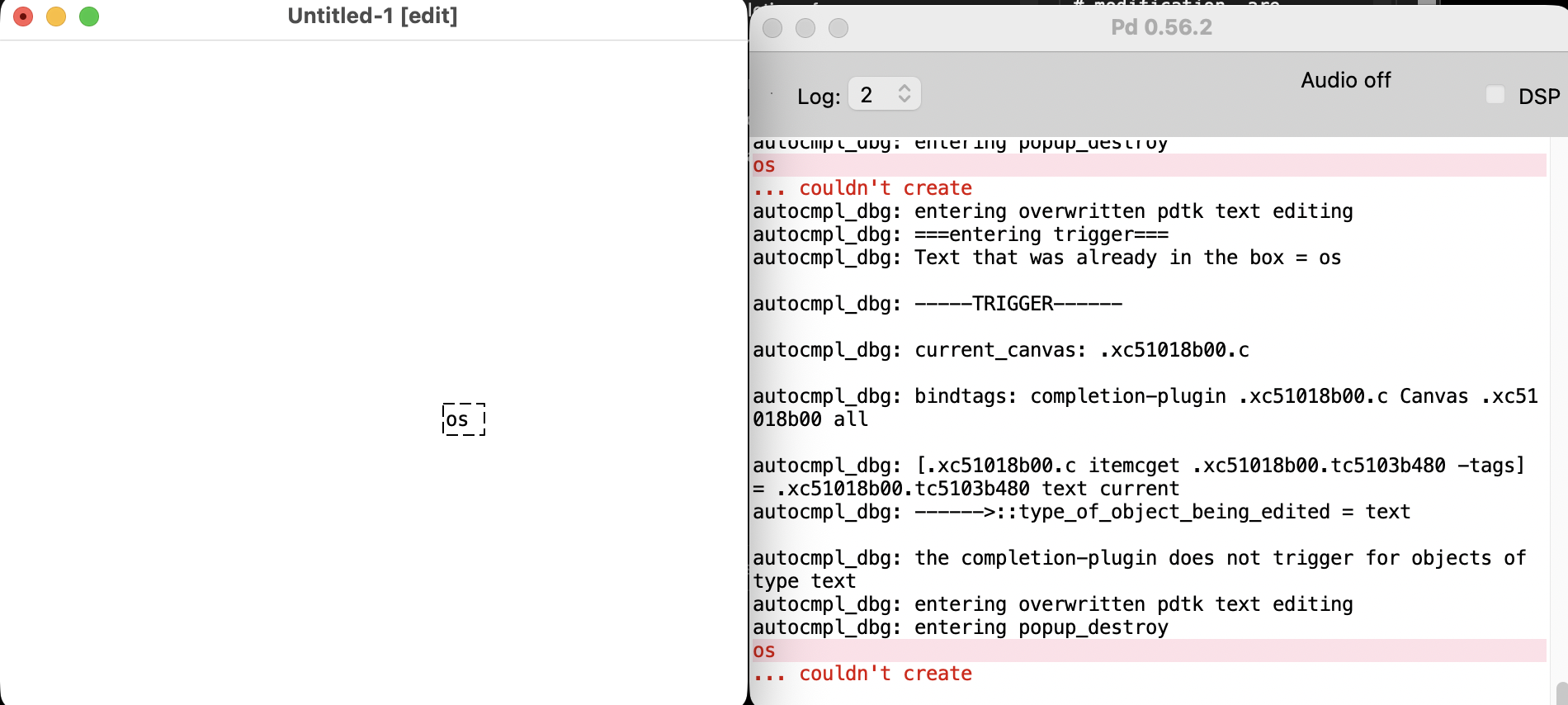
i first tried to figure out a software that would work for me in the long run. i used pure data, but it was very difficult to get a hang of it especially since it has no autocomplete. i even tried an extension, but it didn’t work.
perhaps this is why max charges money.
then, jesse simpson suggested plugdata to me. i didn’t like the interface.
wrote this on tidal cycles:
-- ikeda inspired.

-- after luke's example of a synth in max in sound-studio, i wanted to make something on tidal cycles that was similar.

d1
$ fast 32
$ s "supersaw"
    # freq "840"

-- ^ you play a frequency via a synth.

-- synths live inside the supercollider folder in Application Support.

-- like so:

{-
// a moog-inspired sawtooth synth; slightly detuned saws with triangle harmonics, filter frequency modulated by LFO
// "voice" controls a relative phase and detune amount
(
	SynthDef(\supersaw, {|out, rate=1, decay=0, sustain=1, pan, accelerate, freq,
		voice=0.5, semitone=12, resonance=0.2, lfo=1, pitch1=1, speed=1|
		var env = EnvGen.ar(Env.pairs([[0,0],[0.05,1],[0.2,1-decay],[0.95,1-decay],[1,0]], -3), timeScale:sustain, doneAction:2);
		var basefreq = freq * DirtFreqScale.kr(speed, accelerate, sustain);
		var basefreq2 = basefreq * (2**(semitone/12));
		var lfof1 = min(basefreq*10*pitch1, 22000);
		var lfof2 = min(lfof1 * (lfo + 1), 22000);
		var sound = MoogFF.ar(
			(0.5 * Mix.arFill(3, {|i|  SawDPW.ar(basefreq * ((i-1)*voice/50+1), 0)})) + (0.5 * LFTri.ar(basefreq2, voice)),
			LFTri.ar(basefreq/64*rate, 0.5).range(lfof1,lfof2),
			resonance*4);
		sound = sound.tanh*2;
		Out.ar(out, DirtPan.ar(sound, ~dirt.numChannels, pan, env));
	}).add
);
-}

d1
-- $ echo 16 0.5 0.5
$ fast 16
$ s "supersaw"
    # freq (stack [
        range 0 840 $ slow 16 tri,
        range 0 640 $ slow 16 tri,
        range 0 340 $ slow 16 tri,
        range 0 540 $ slow 16 tri
        ])
--   # freq ([range 0 840 $ slow 16 tri])
  # gain 0.75
  # lpf 900
  # delay (range 0 0.5 sine)
  # delayfeedback 0.2
  # hpf 1500
  # gain 0.8

  d2
--   $ fast 2
  $ stack [
    n "bd bd bd bd"
    # s "808bd"
    # gain 1.2
    # delay "0.2"
    # lpf 800
  ]

  d3
  $ stack [
    -- s "hh hh"
    s "hh*4",
    (s "sd*2" # lpf (range 1000 3000 sine))
    -- (s "ho" # hpf "10000" # echo 16 0.1 0.5)
  ]

  d4
  $ echo 24 (-0.25) 0.75
  $ s "ho"
  # hpf 12000

d5
$ freq "<40 50 40 30>"
-- $ n "0 3 5"
    # s "superfm"
    # attack 0.2
    # hold 1.5
    # rel 0.2*2
    # gain 1
i had an idea to use someone else’s voice to play a certain song. when i looked at luke dubois’s patch & recording, it was too much to handle.
so, instead, i just used this time to practice some composition.
tried to get the autocomplete to work in pure data. failed.
figured out simple signal generators; called it a day.
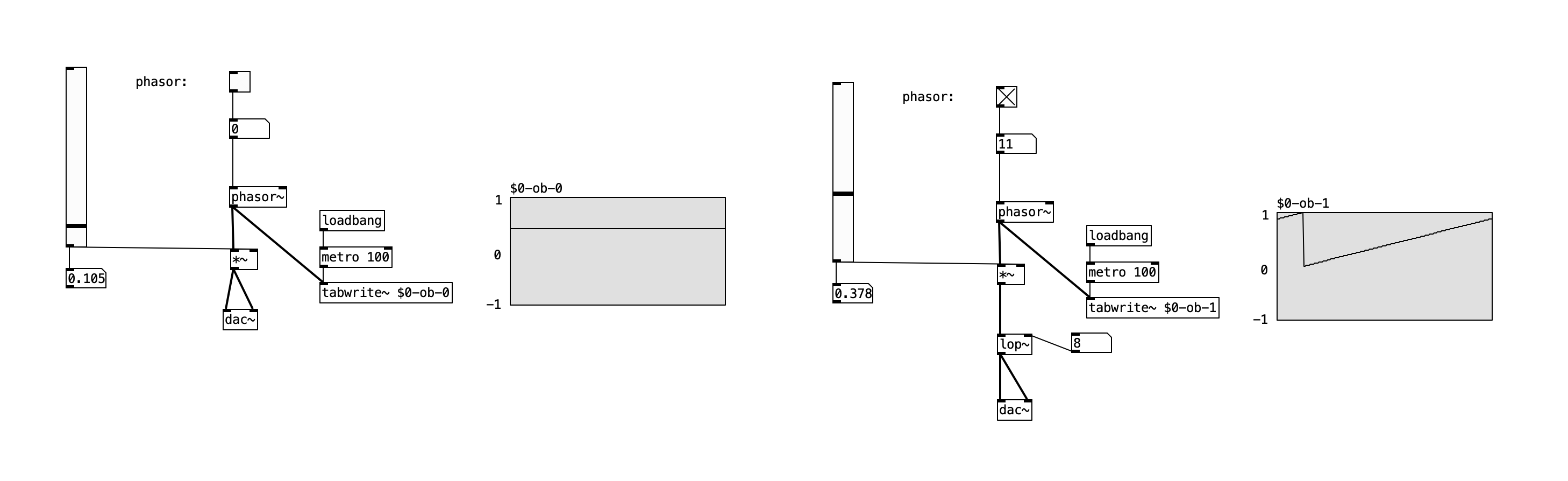
at the end of the day, max or pure data are both simply programming languages. just like tidal-cycles is too.
at the end of the day, this class is about exploring sound. i think i’ve done enough:
- i learnt how to use analog-synthesizers, via work i did in the audio-lab.
- learnt more about the electronics & theory of how sound is composed.
- explored how to make sound electrically, programmatically & with a visual software.
- built two analog instruments for my midterm.
so, now, it’s about the final project. there are a few ways i can think about this:
- one is to think about it as a project. that way, my synth wall is probably the best thing i have at the moment. it:
- gives me a big physical project.
- allows me to continue exploring electronics.
- actually make a shareable project about sound.
- second is to think about it as a way to explore composition. i understand more about myself sonically, by choosing a program and sticking with it (perhaps tidalcycles or pure-data).