reading:
read ch. 3 thought, from a world appears: a journey into consciousness.
- what consciousness conjures up is weakly communicated via words (it conjures up feelings, images, sensations, et-cetera):
-
“mentation—are preverbal, often showing
up as images, sensations, or concepts, with words trailing behind as a kind
of afterthought. ”
-
- abstraction leaves out nuances; but abstraction is essential to be communicable.
-
“Hurlburt’s antipathy toward theory is key to understanding what he’s attempting to do, and why he was so gruff when I told him I was writing a book on consciousness. (“Good luck with that,” he grumbled.) He treats theory as something you might catch, and he strives to keep it out of his research—indeed, out of his mind—lest it infect his sampling process. Because that involves closely questioning volunteers about their inner experiences, the slightest theoretical taint to his questions could easily contaminate the reports of his volunteers and ruin their empirical value.”
- on the book — one boys day: “The other problem was that it took a whole book to write about one person on one day.”
-
“the act of recalling and describing an experience is bound to alter it”
-
“I’ll point out that there are at least two different modes of experiencing: one that’s before the footlights of consciousness and one that is happening more or less on autopilot, or backstage.”
-
“I didn’t realize there was a third option: “unsymbolized thoughts,” or complete thoughts made up of neither words nor images. In fact, many subjects are unaware of the phenomenon and assume they’re failing at the task if they can’t attach words or images to their beeps.”
-
"If mind-wandering describes a meander, rumination describes a loop or a spiral."
-
”(“The big lesson of meditation,” she said, “is that the mind cannot be controlled.”)” — kind of what i was saying in sm_class-1.
-
“One of the most frequently cited papers in psychology, it concludes that people are happier when their minds are engaged in a task rather than wandering." → A Wandering Mind Is an Unhappy Mind.
-
“Both Christoff Hadjiilieva and Hurlburt suggested that scrolling on smartphones has cut into the time we once spent in mind-wandering and other forms of inner experience. Our distractions may be shrinking the dimensions of our interiority."
-
“I asked Ellmann whether or not she had done any research into the science of consciousness before writing Ducks. “No, I didn’t read any of that. I thought, I have one right here. I’m going to study mine.”
felt that the reading was very dense, and that different people have approached the study of consciousness in different manners — none better than the other; because no one can fairly assess.
writing:
ask: How do you think? What is your stream of consciousness like? Do you feel like you are aware and in control of your thoughts? Do you decide to think your thoughts or do they just occur to you. Are you generally aware that you are thinking or are you usually “lost in thought?” Are your thoughts delivered as voices. Do your thoughts repeat? Are your thoughts mostly positive or negative? Do you think one thought at a time? Are you the same person over time? What makes one thought follow another? Do you always feel like there are many candidates for a connecting to a following thought? How can you better get to know how you think?
thinking.
perhaps one of the few things that i like about myself is the ability to think freely (see 2608-mapping). while teaching, i often compared the brain as a muscle that must be stretched — and, thankfully, i’ve retained the flexibility of mine over the years. thinking & mapping — for me — has become inextricably linked. i think in bubbles & branches, and i represent thinking in bubbles & branches.
i often think of thinking as a wave — it comes to you, as you’re floating on an ocean — and it takes you somewhere. and that’s it — you have illusory control (i can try making it think of a certain thing by forcing it to focus on more contextual stimuli), but that’s it — the control is an illusion.
i wonder what positive thoughts are. or negative ones. thoughts are simply thoughts — their effect on me, however, is contextual. for example: thinking about a person at a certain point in time in a certain environment evokes a ‘positive’ feeling; but the same may evoke a negative one in another setting. i argue that thoughts are neutral, but their perception is affective.
i am aware that i am thinking. because i am always thinking. i sometimes think of the brain as a gpu — even when i must be ‘present’, i am in parallel processing. i know this because there has been one time — only one time — that i’ve had illicit-brownies with taksh & sakina. gosh: when i regained control, it was horrible. everything was silent — i remember complaining that i couldn’t think. at most, i could think of one thing at once. there was no pressure — it was all light. i hated it; i felt like i had caused myself brain-damage; i cursed & complained. the next day it all came back; the familiar weight; the simultaneous processing; the uncontrollability & omnipresence of my thoughts.
i actually do a lot of mind-wandering. usually it feels like i have some amount of control, and i let it loosen when i say — go “wander”. and then it does what it does. it happens when i cycle; it used to happen when i ran & hiked. and i have to make time for it to wander — otherwise it doesn’t function well when i want it to. although more often than not — perhaps because context & general social anxiety — it behaves when it needs to. i am certain that i am not in control, but that we’re in a healthy symbiotic relationship with each other. it often brings me hell, but i won’t make much progress without it.
even when reading the book, i wondered why i was not curious to ‘better understand’ how i think. to me, the idea of studying something is often to, later, exercise control over it. even meditation — gosh, why would i want that? people argue that it ‘calms’ you down; or it helps bring more clarity. i’ve somehow not felt the need for it. i think the exploration comes because of the chaos, and the criticality comes after the vomiting of the chaos. my brain just works that way — it needs to run free and hop from station to station, and then see its journey to decide the correct path. see 1, 2, 3.
so, i don’t think i want to know more about how it happens. i just want to do it more. i want to get comfortable with it (and that happens by doing). i want to do more of it. i want to enable it to do better. i want it to happen to me, rather than me trying to make it happen to it. am i lazy? is this an easy way out as a researcher? perhaps; yes.
making:
ask: Abraham Lincoln was quoted as saying “ Give me six hours to chop down a tree and I will spend the first four sharpening the ax.”. As much as we love the p5 web editor because it is simple and cloud based, you might consider editing your code in a more powerful environment. An environment is basically the text editor for your code but these days they also do stuff like formatting, running, sharing and even writing your code for you. Eventually upgrading your environment will help you tie into the bigger ecosystem of machine learning.
Within that environment, see if you can make a vanilla javascript canvas that records your stream of consciousness. If you can just get my examples working in your new environment, that would be great. But maybe try having the text field that creates thoughts that bounce around the screen like the might bounce around your head. Maybe have them grow if you click on them and decay if you don’t. Maybe try getting AI to add a button for you? If this is all easy for you think about other input like voice or body.
divided into two parts: setting up the environment, and the stream-of-consciousness thing:
environment:
the first hurdle was to figure out an environment. i usually use vim for scripting, and vscode for large codebases. at recurse-center, i messed around with a few open-source, locally-hosted a.i. agents; and realized that they produced garbage (and that too slowly (see ai assistant explorations)).
the obvious step is to use external compute power — which usually comes with costs. i know that claude-code is the industry standard. jagi used it well. that’s 20$ a month.
dan-o’s recommendation was to have an ide with an agent built in, so that you can see changes that an agent makes. nikolai suggested that i use an agent to design the perfect environment for myself.
the no-brainer for models & agents is claude. the question then is the ide.
i decided to work with claude & neovim — simply to avoid clunk.
first, i uninstalled everything that i originally had — opencode, ollama, et-cetera.
the first thing i noticed was that claude-code ran caffeinate by itself, and that made me uncomfortable that it can run processes in the background. so i dived into that:
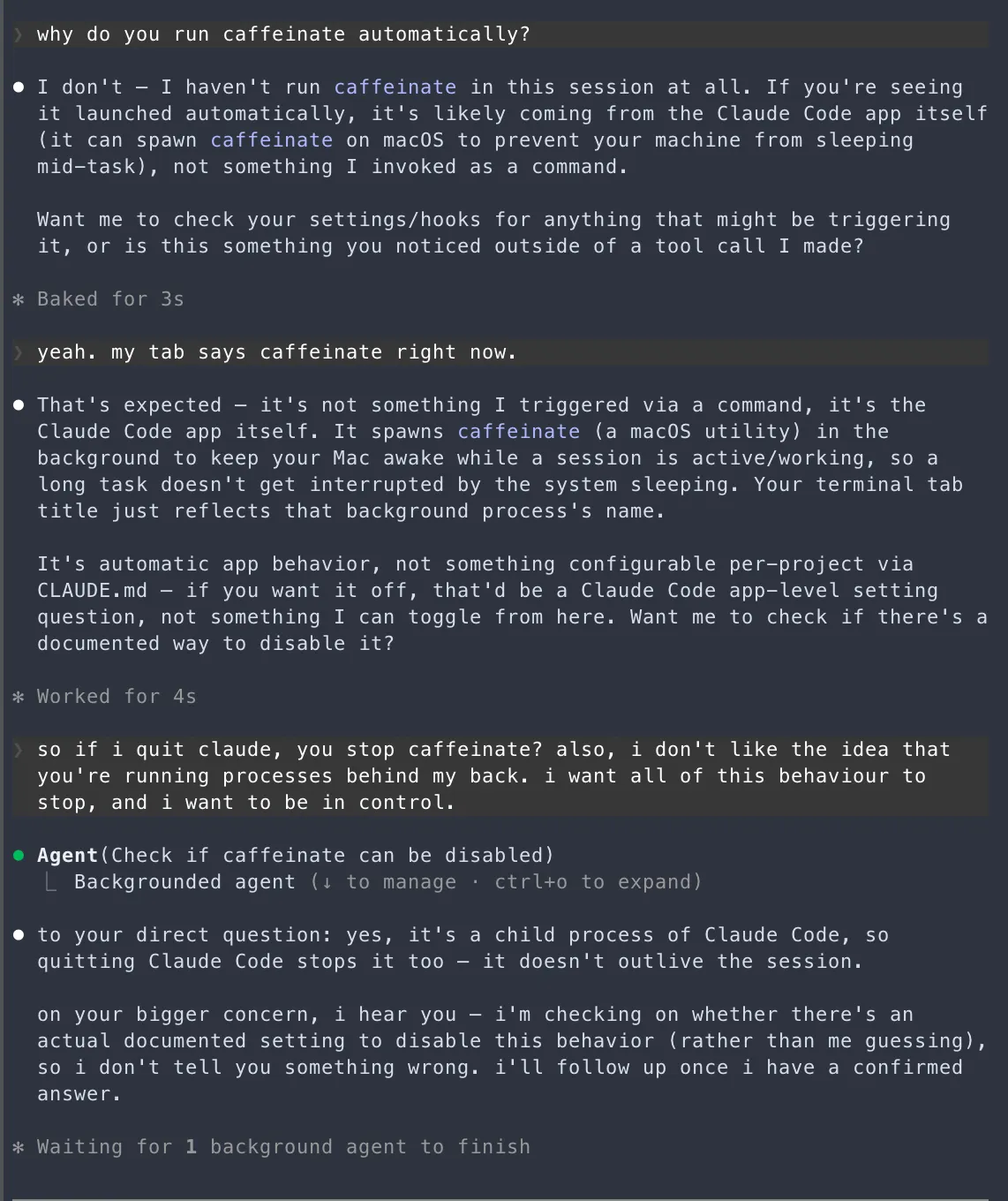
after a couple of hours of fiddling around, i got it right where i want it — changed all privacy settings, set up the CLAUDE.md file, and configured it to view diffs in nvim.
i then messed around with a few old repos to see how good it was, and if i was confident of reverting back changes. i disallowed it to add itself to my github-contributors for any repo, and basically disallowed it to do any git commands. this way, version control is in my hand, and i can revert to a previous version if it messes up.
stream of consciousness:
making something that records my ‘stream of consciousness’ is not helpful for me. i don’t see myself using it. when my brain is wandering, it is wandering. if it has moved on from a thought, it has made progress — i don’t feel the need to store it & to relook at it. i’ve already made progress.
however, when i think ‘freely’ for a task: say to generate ideas; or to explore something conceptually, it helps me to see the evolution of my thought. this is because in that moment, i am trained enough to make it go back to an older thought, and focus on that (for example in 2608-mapping).
in the past, i’ve tried to make mapping software myself — over weeks of effort. i got very close with one earlier. so, i’m pretty sure i know what i want conceptually — and now i can get an a.i. agent to do it for me.
i did think about social-thinking tools — for two people to explore the journey of their brains together (given a prompt word); but i’ll hold off on it now. it doesn’t feel right.
thinking:

structure:
exploration will happen around a central question. in the center.

the canvas must be infinite, zoomable, scrollable.

there have to be modes:
- alternate branching
- or sub branching.

the interface must be voice. must be editable via keyboard & mouse too. a sample flow would be:

- central question state: a better phone
- should have less ...
- should have this
- that

pick a node, and go sub branches into that. sub-branch mode is often good for why-deep dives.

-

gaps between words register it as a bubble or a separate bubble.

commands need to be explicit. i can't have an llm parsing from this.
i then started getting an agent to build it — functionality by functionality. before moving onto a major step, i would ask it to do this when we successfully completed a stage:
before we move further, i need you to thoroughly clean up the codebase. format it, add comments where they ought to be, remove redundancies, and expose variables that i need to have control over.
output here:
interactive prototype: https://arjunmakesthings.github.io/shared-minds_f26/week-1/