when i think about the world, i imagine a system — many organisms perpetually interact with one-another, each governed by its own set of rules, collectively unpredictable & complex; with the occasional sprinkle of universal noise. my artistic practice is wholly devoted towards the pursuit of understanding and representing this semi-ordered nature of the world.
my thesis develops this original enquiry, with the intention of opening up a more focused explorative & exhaustive space for myself (and other interested people).
consider how little of your life is spent in biological-necessities — eating; resting; staying safe; et-cetera. more of it is spent in acts of curiosity — why something happened; what something feels like; how something works; who someone is; et-cetera. kidd & hayden write that ’ (about curiosity) we are nearly oblivious to its pervasiveness in our lives’ 1.
think about the last time you fought with a friend — how did you make sense of the situation? you, perhaps, spent time analyzing all the individual parts that contributed to the escalation: the situation, what you did before, what you ate, the weather, your history, et-cetera; and attempted to arrive at some sort of rationale that explained their reaction.
this — what you just did above — is more formally practiced in science as the study of complex systems 2: emergent, unpredictable, phenomenon is broken down into simpler, interconnected parts, in an attempt to better understand why something happens the way it does. as an artist, my work attempts to invite people to the expressive-potential of the study of complex systems.
in summer-2026, i produced a body of work that showed signs of concretizing this enquiry. an unpublished video can be seen here (to be released later this year by the processing foundation). a written explanation is below:
inspired by life in new-york, i produced a simple (highly-reductive) system of what it felt like to be in new-york.
there is a world. the world is a container, and consists of many places.
the world contains a population of beings — who are born, sustained, and killed over time by the world.
the beings express life through movement, and movement is governed by a schedule. both the schedule & movement are governed by age (for eg: the closer you are to your 20s, the more likely you are to have a busier schedule (and thereby have to move more)).
here is a picture of the base-system:
what is, however, shown to a person is not the system, but software-interpretations of it — the artist (myself) decides what to show from the simulation.
for example, an interpretation i showed was titled ‘missed connections’. here, i drew a black line between two beings within a specific radius; while at-least one of them was traveling. the closer they were, the thicker the lines. this was shown over time.
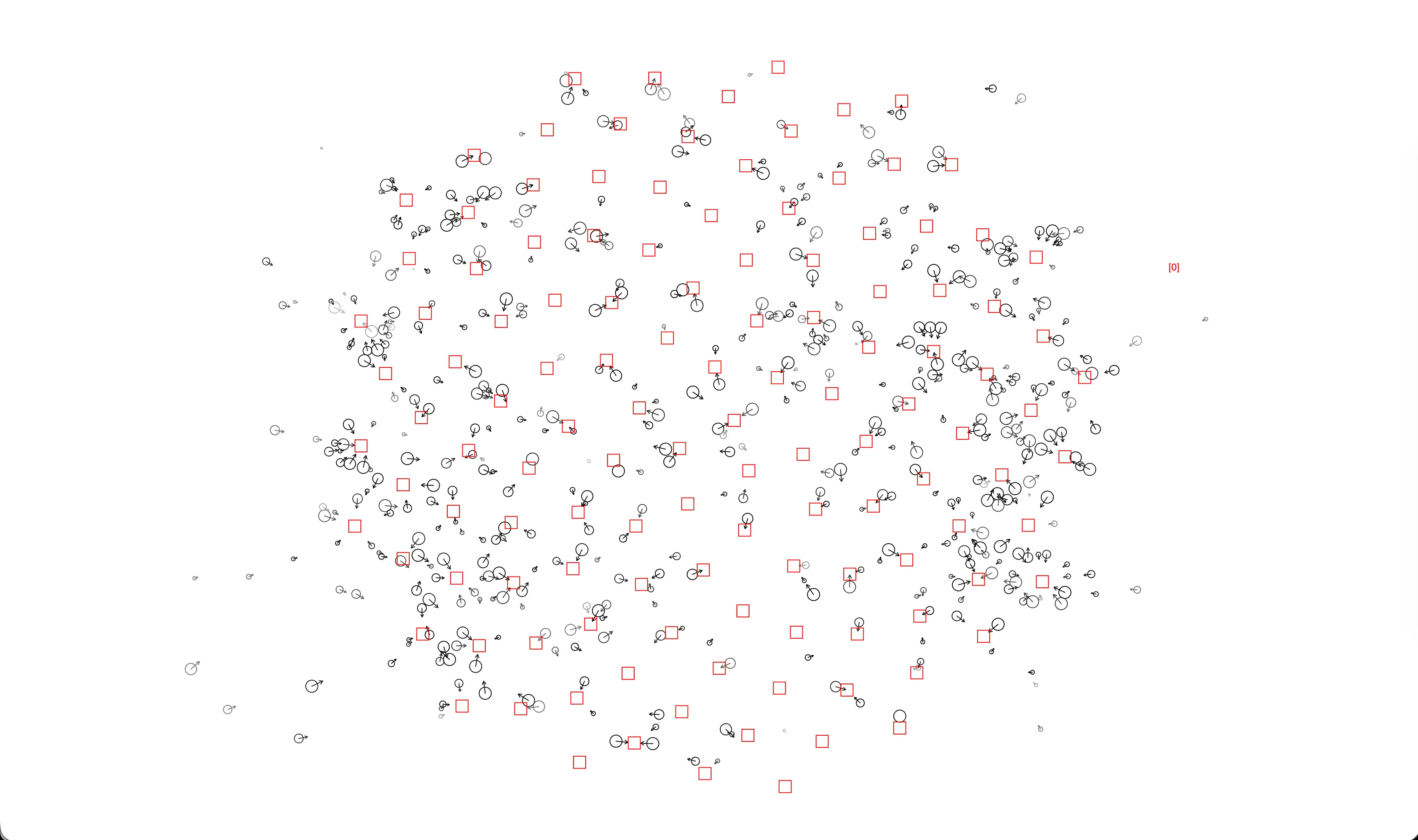
while explaining the piece above, i said: "this is what it feels like to be on a subway station", and immediately found resonance in the audience. months later, a friend, kavya, said: “i was on a subway station with many people, and all i could see were the missed connections (as a callback to my piece)”.
those two moments solidify my original intuition: complex human-phenomenon (such as my loneliness in a city) can be expressed in a more relatable manner, as an expression of a complex-system that reductively breaks the phenomenon down into simpler parts.
in my thesis, i wish to encode & express phenomenon in three different (human) buckets:
- movement
- communication
- sharing
some examples of relevant phenomena are:
- herding → movement.
- loss → communication.
- bad actors in equal distribution of resources → sharing .
^ these are examples, and not the exhaustive list of behaviors i wish to encode.
expression requires computation. however, the only accessible way to, currently, perceive said computation is through a computer-screen. that is not good enough.
each bucket affords an explorative space of an alternative-display-paradigm. for example: what happens if entities that make up the display (traditionally pixels) for ‘movement’ can actually move in physical-space? my belief is that:
(a) the expression becomes more ‘emergent’ (and, therefore, truer), because universal noise affects it.
(b) certain rules that image-representation requires go away. therefore, the space opens up to new possibilities of what a ‘display’ can be.
(c) the unpredictability of the resulting image (or sound) forces the encoder to more deeply examine the system they encoded. therefore, the focus is not on the expression, but the encoding (and, therefore, the understanding & translation of the phenomenon they were trying to express).
(d) the experience of an expression becomes more powerful. this is just an intuition from years of looking at work: i have no scientific explanation for this.
current explorations: