ask:
This “mid-semester exercise” can be anything that builds off of or is inspired by the material from the motion and physics material. It does not need to be a “fully realized thing” — it can be a visual experiment in progress or a piece of a larger project you are building for another context (thesis, another class, etc.).
thought:
i spent time getting reacquainted with the idea of ‘rule-based art’. when i taught computational-sketching, i used examples of sol-lewitt and yoko-ono to introduce the idea of an ‘algorithm’ to students.
in noc_class-6, we also watched casey reas’s process compendium together, which was built around the idea of emergence — put a few rules together, and see the outcome that emerges.
i wanted to take the two lines — instructions & emergence — further.
when you look at the rules of these ‘programs’, much of it seems arbitrarily decided. the process veers more towards cyberdelia — i discover myself through computational means.
i wanted to be more intentional about the rules, and model them based on felt experience. therefore, the piece & the rules that make the piece become the emergent expression of a particular feeling.
outputs:
my rule-set was the following:
there is one world, and is created during the big-bang.
the world has beings. beings do the following:
- they are born.
- they exist.
- while existing, they move:
- movement happens according to a schedule, that the world generates for them.
- they are constrained to the surface of the world.
- while existing, they move:
- they die.
the world keeps time. each day is day_length units long.
rules can be visualized like so:
interpretation strand followed was this:
- beings are grouped together at birth, based on the proximity of being born next to other beings. groups are shown as filled or outlined objects. for example:
fill with stroke:
only stroke:
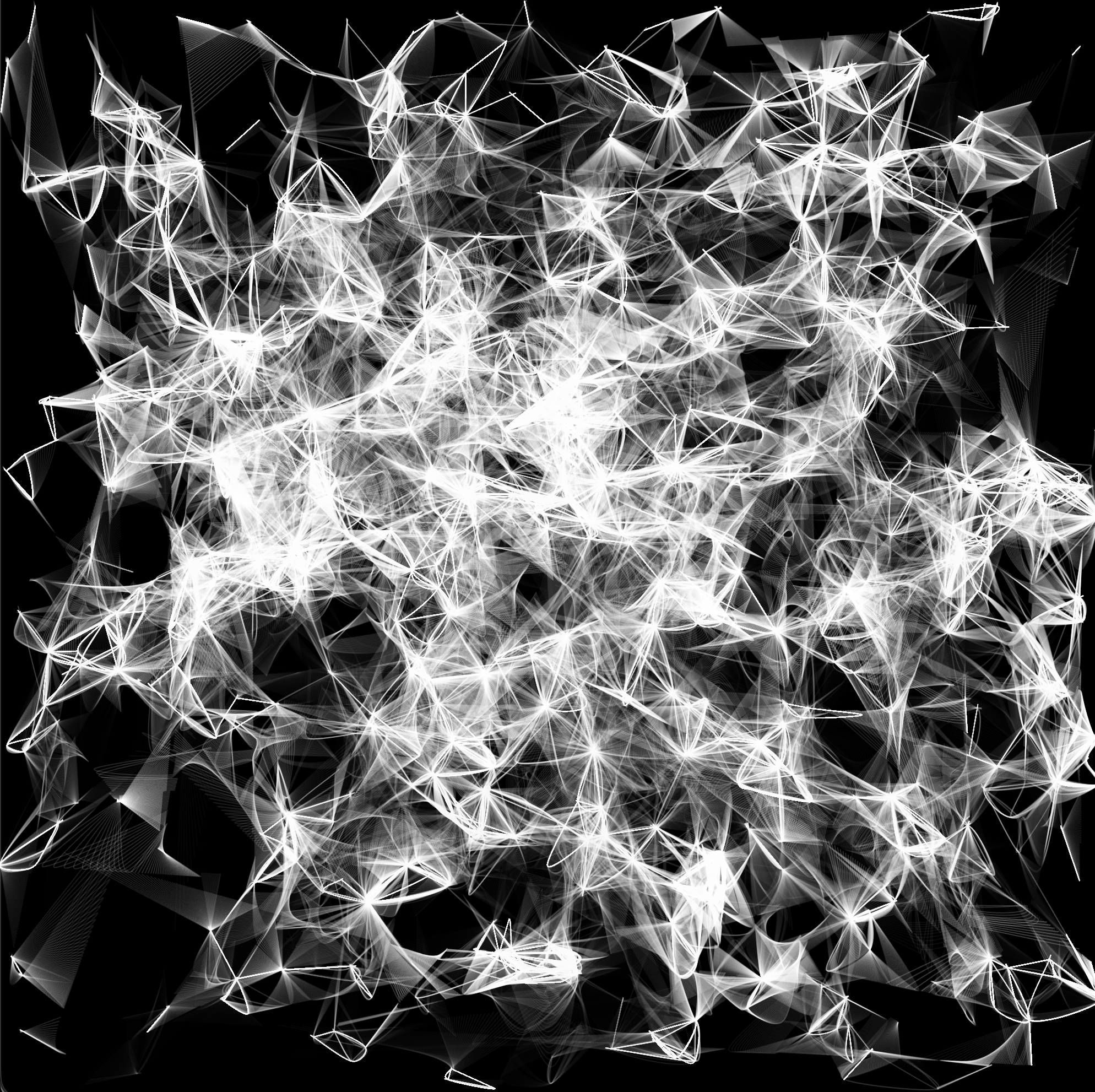
i am unhappy with my lack of exploration for the interpretation, but happy with my programming of the initial ruleset.
process-log:
i decided to derive rules based on social-exclusion.
the first distinction i must make is that my definition of rules does not encompass the whole phenomenon. it is purely a projection of how i think the world works — how certain groups get ahead, and others die.
the other thing i must accept is that i myself cannot know what this outcome will produce. i can simply develop the rules, and then come up interesting ideas for what is visually represented.
so, the first step is the expression of the rules:
there is a world and there is a unit.
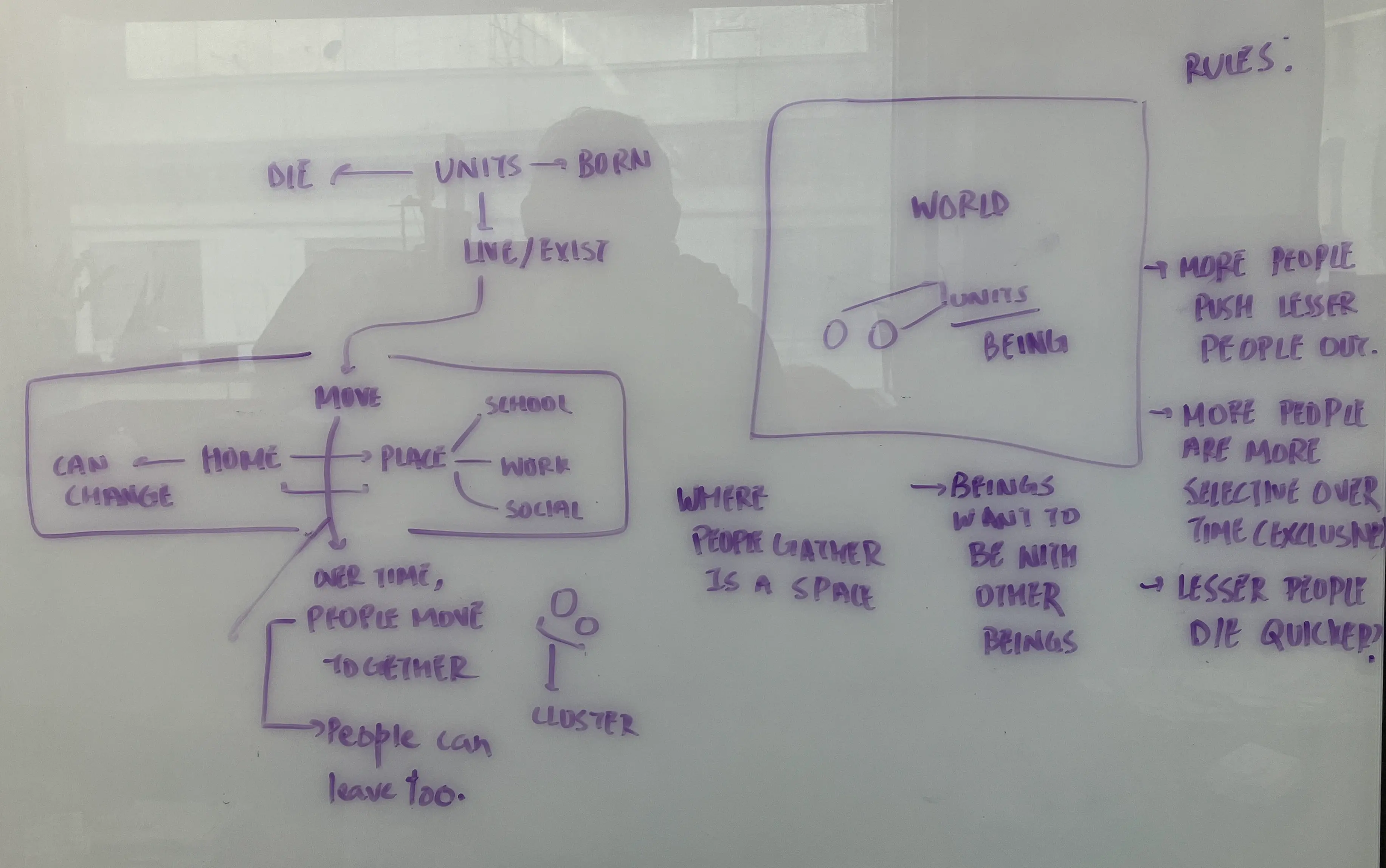
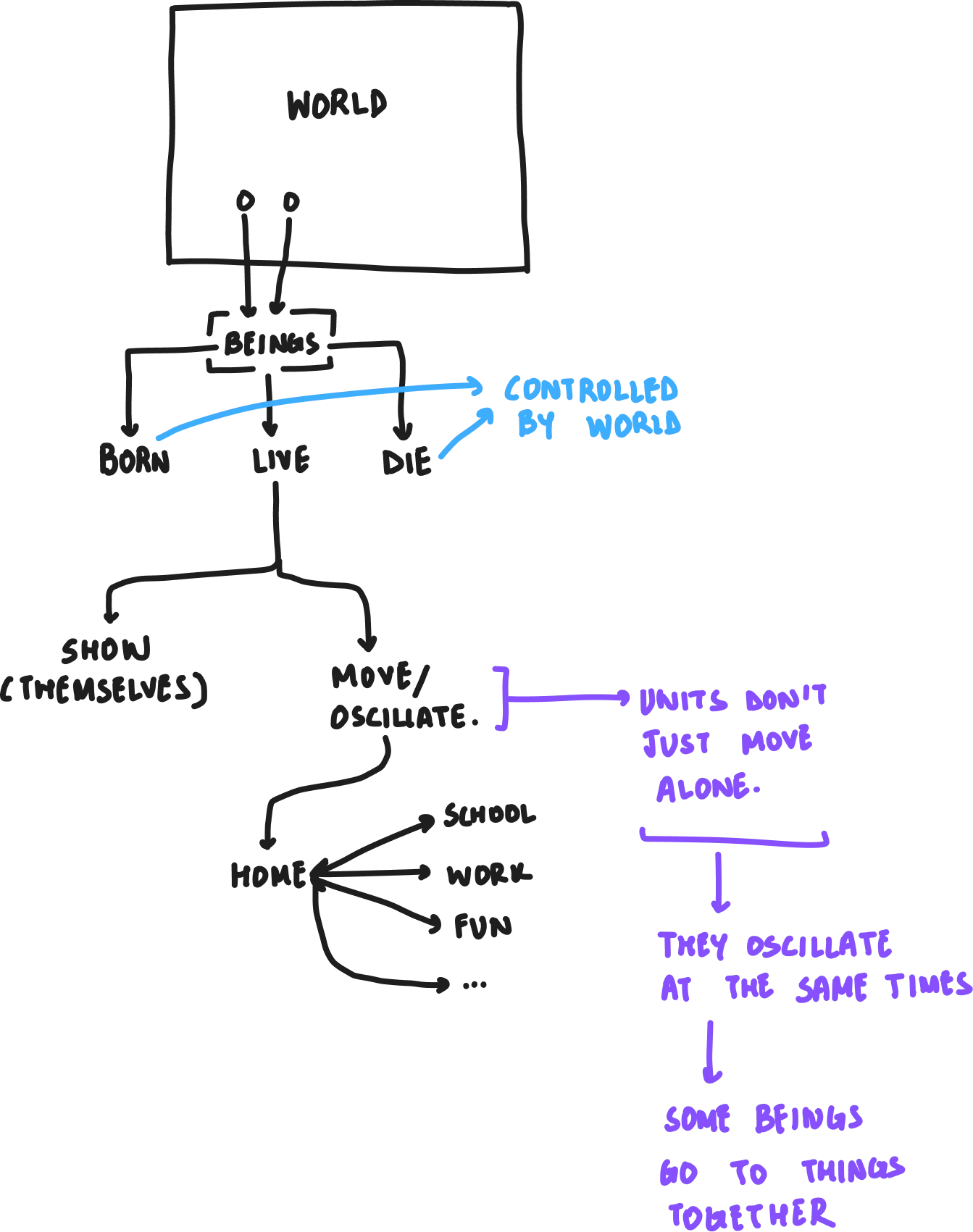
i first tried to write a very complex program, and it did not work.
//untitled; arjun; month, 2026.

/*
ask:

*/

/*
thought:

*/

//there is a world, and there are beings in the world.

let world;

let margin = 100;

function setup() {
  // createCanvas(1000, 562); //in 16:9 aspect ratio.
  createCanvas(800, 800); //square to handle calculations better.

  world = new World(width, height);

  world.big_bang();
}

function draw() {
  world.run();
}

class World {
  constructor(w, h) {
    this.w = w;
    this.h = h;

    this.time = [0, 0, 0, 0];
    this.day = 0;

    this.beings = [];
  }
  big_bang() {
    this.beings.push(Being.birth(this.w / 2, this.h / 2));
    // this.beings.push(Being.birth(this.w / 2, this.h / 2));
  }
  run() {
    background(0);

    this.keep_time();

    for (let being of this.beings) {
      being.exist();
    }

    // //every x second, a new unit is added into space.
    if (frameCount % 60 == 0) {
      // this.units.push(Unit.birth(random(margin, this.w), random(margin,this.h)));
    }
  }
  keep_time() {
    const ms = millis() - this.day;
    const seconds = Math.floor(ms / 1000) % 60;
    const minutes = Math.floor(ms / (1000 * 60)) % 60;
    const hours = Math.floor(ms / (1000 * 60 * 60));

    // When a minute passes, reset loopStart
    if (seconds >= 10) {
      this.day = millis();
      this.time[0] = 0;
      this.time[1] = 0;
      this.time[2] = 0;
      this.time[3] = 0;
    } else {
      this.time[0] = Math.floor(ms);
      this.time[1] = seconds;
      this.time[2] = minutes;
      this.time[3] = hours;
    }

    console.log(this.time);
  }
}

class Being {
  constructor(x, y) {
    this.pos = createVector(x, y);
    this.home = this.pos;
    this.age = 1;
    this.aging_rate = 0.37;

    this.other_places = [this.home.add(random(20, 50))];
  }
  static birth(x, y) {
    return new Being(x, y);
  }
  exist() {
    this.show();
    this.grow();
    this.move();
  }
  show() {
    noFill();
    stroke(255);
    circle(this.pos.x, this.pos.y, 10);
  }
  grow() {
    const prev_age = Math.floor(this.age);
    this.age += this.aging_rate;
    const curr_age = Math.floor(this.age);

    if (curr_age > prev_age) {
      //happy birthday:
      this.other_places.push(random(width / 2, height / 2));
    }
  }
  move() {
    if (this.time )
  }
  static death() {}
}
there were too many variables for me to focus on.
i think this is why generative art that focuses on emergence has a simpler set of rules.
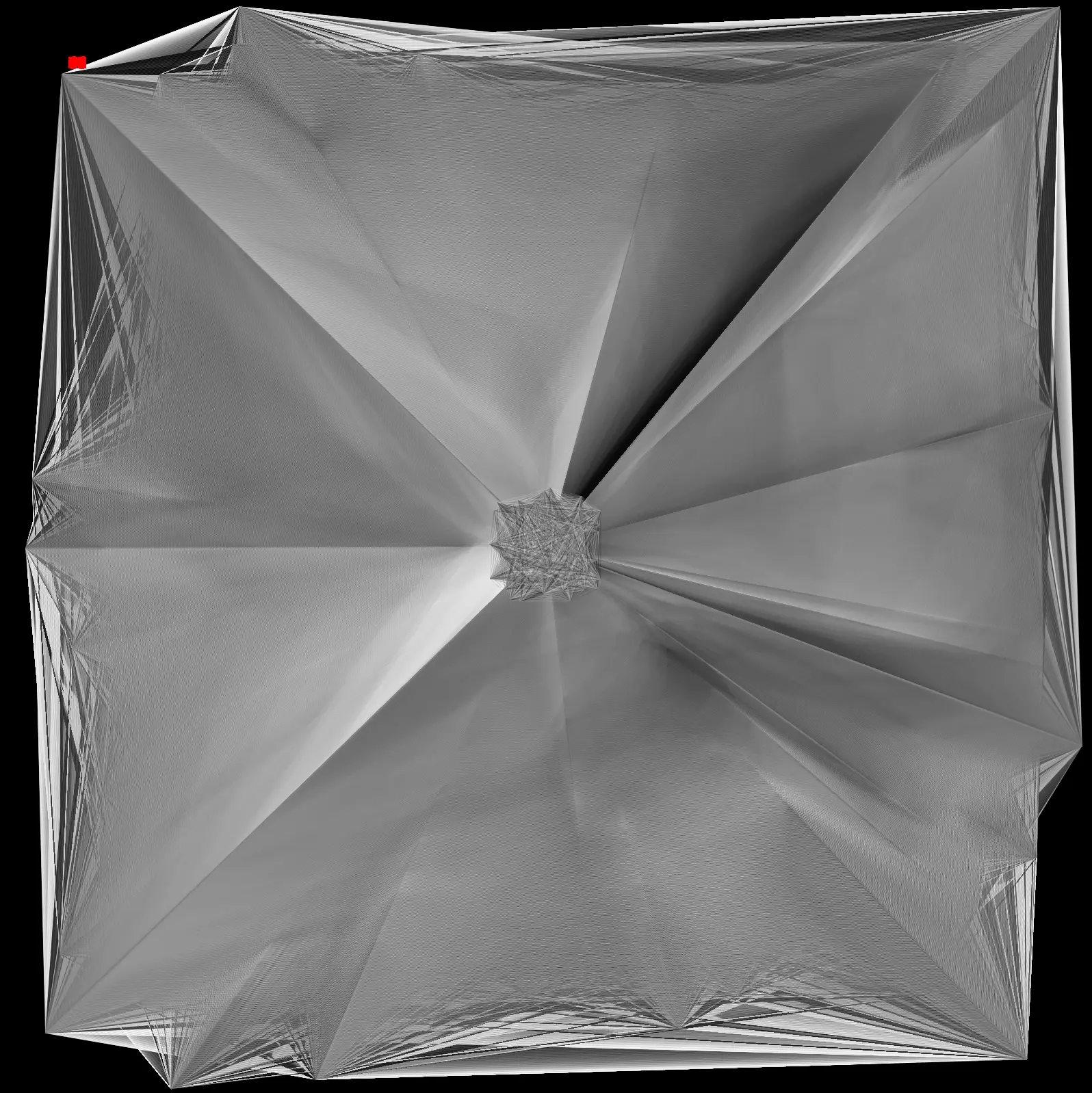
made this:
code:
/*
untitled; by arjun; march 2026.
simple system:

- there are beings the world.
- beings move, and stay on surface.
- beings close together cluster together.

*/

let beings = [];

let num = 100;

function setup() {
  // createCanvas(1000, 562); //in 16:9 aspect ratio.
  createCanvas(800, 800); //square to handle calculations better.

  for (let i = 0; i < num; i++) {
    beings.push(new Being(width / 2, height / 2));
  }

  //clear canvas with a black background.
  background(0);
}

function draw() {
  // background(0);
  for (let being of beings) {
    //being.show();
    being.move(time);
  }

  for (let i = 0; i < beings.length; i++) {
    for (let j = 0; j < beings.length; j++) {
      if (i === j) continue;

      strokeWeight(0.08);
      if ((i + j) % 2 === 0) {
        stroke(255, 100);
      } else {
        stroke(0, 100);
      }
      line(beings[i].pos.x, beings[i].pos.y, beings[j].pos.x, beings[j].pos.y);
    }
  }

  keep_time();
}

class Being {
  constructor(x, y) {
    this.pos = createVector(x, y);
    this.home = this.pos.copy();
    this.dest = this.home.copy();

    this.other_places = [createVector(random(0, width), random(0, height))];

    this.vel = createVector(0, 0);

    this.last_time = 0;

    this.pace = random(0.5, 2);
  }
  show() {
    noFill();
    stroke(255);
    circle(this.pos.x, this.pos.y, 20);

    //this.show_places();
  }
  show_places() {
    for (let i = 0; i < this.other_places.length; i++) {
      noFill();
      stroke(255, 0, 0);
      circle(this.other_places[i].x, this.other_places[i].y, 50);
    }
  }
  move(time) {
    let norm_time = Math.floor(map(time[1], 0, 30, 0, 24));

    noStroke();
    fill(255, 0, 0);
    text(norm_time, 50, 50);

    if (norm_time < 8) {
      this.dest.set(this.home);
    } else if (norm_time >= 8 && norm_time < 17) {
      this.dest.set(this.other_places[0]);
    } else if (norm_time >= 17 && norm_time < 20) {
      let n = Math.floor(random(this.other_places.length));
      this.dest.set(this.other_places[n]);
    } else {
      this.dest.set(this.home);
    }

    if (norm_time === 23 && this.last_time !== 23) {
      //new day:
      this.other_places.push(createVector(random(0, width), random(0, height)));
    }

    this.last_time = norm_time;

    // Calculate direction and distance
    let d = p5.Vector.sub(this.dest, this.pos);
    let distance = d.mag();

    // Slow down as you get close (max speed = this.pace, min speed = 0)
    let speed = map(distance, 0, 100, 0, this.pace); // 100 is the "slowing radius"
    speed = constrain(speed, 0, this.pace);

    if (distance > 1) {
      d.setMag(speed);
      this.vel = d;
    } else {
      this.vel.set(0, 0);
    }

    this.pos.add(this.vel);
    this.stay();
  }
  stay() {
    if (this.pos.x >= width || this.pos.x < 0) {
      this.vel.x *= -1;
    }
    if (this.pos.y >= height || this.pos.y < 0) {
      this.vel.y *= -1;
    }
  }
}

//helper to keep time.
let day = 0;
let time = [0, 0, 0, 0]; //ms, seconds, minutes, hours.

function keep_time() {
  const ms = millis() - day;
  const seconds = Math.floor(ms / 1000) % 60;
  const minutes = Math.floor(ms / (1000 * 60)) % 60;
  const hours = Math.floor(ms / (1000 * 60 * 60));

  //one minute loop.
  if (seconds >= 30) {
    day = millis();
    time[0] = 0;
    time[1] = 0;
    time[2] = 0;
    time[3] = 0;
  } else {
    time[0] = Math.floor(ms);
    time[1] = seconds;
    time[2] = minutes;
    time[3] = hours;
  }
}
not particularly accurate in terms of what i wanted to get done. but it’s ok.
i realized that my thinking wasn’t clear. i referenced process compendium again. he had simple rules, such as:
B1: Move in a straight line
B2: Constrain to surface
B3: Change direction while touching another Element
his thinking was very clear:
The most important element of Process is the text. The text is the Process described in English, written with the intent to translate its content into software. The Elements, Forms, and Behaviors referenced within the Process text are defined in the Library. The software interpretation is secondary to the text. The text leaves many decisions open to the programmer, decisions that must be made using personal judgment. The act of translating the Process from English into a machine language interprets the text. Process was implemented by into the language in . The hardware is inconsequential and in time it will fail. It was selected to be robust, but electronic devices are fragile. If a component of the hardware fails, it may be replaced without diminishing the work. Eventually, compatible components won’t be available. When this happens, a new hardware system must be acquired and the software modified for the new platform.
The Elements, Forms, and Behaviors referenced within the Processes are defined in the Library:
Forms
F1: Circle
F2: Line
Behaviors
B1: Move in a straight line
B2: Constrain to surface
B3: Change direction while touching another Element
B4: Move away from an overlapping Element
B5: Enter from the opposite edge after moving off the surface
B6: Orient toward the direction of an Element that is touching
B7: Deviate from the current direction
Elements
E1: F1 + B1 + B2 + B3 + B4
E2: F1 + B1 + B5
E3: F2 + B1 + B3 + B5
E4: F1 + B1 + B2 + B3
E5: F2 + B1 + B5 + B6 + B7
untitled:
there is a world. a world keeps time, and runs on days. a day is 24-second long by human-time.
a world is made of beings.
base structure:
/*
there is one world, and is created during the big-bang.

the world has beings. beings do the following:
- they are born.
- they exist.
- they die.

*/

let world;

function setup() {
  createCanvas(1000, 1000);

  world = new World(0, 0);
  world.big_bang();
}
function draw() {
  world.run();
}

class World {
  constructor(x, y) {
    this.x = x;
    this.y = y;

    this.beings = [];
  }
  big_bang() {
    let x = width / 2;
    let y = height / 2;
    this.beings.push(Being.birth(x, y));
  }
  run() {
    background(0);

    for (let being of this.beings) {
      being.live();
    }
  }
}

class Being {
  constructor(x, y) {
    this.pos = createVector(x, y);
  }
  static birth(x, y) {
    return new Being(x, y);
  }
  live() {
    this.show();
  }
  show() {
    noFill();
    stroke(255);
    circle(this.pos.x, this.pos.y, 20);
  }
  static death() {}
}

//helper to keep time.
let day = 0;
let time = [0, 0, 0, 0]; //ms, seconds, minutes, hours.

function keep_time() {
  const ms = millis() - day;
  const seconds = Math.floor(ms / 1000) % 60;
  const minutes = Math.floor(ms / (1000 * 60)) % 60;
  const hours = Math.floor(ms / (1000 * 60 * 60));

  //one minute loop.
  if (seconds >= 30) {
    day = millis();
    time[0] = 0;
    time[1] = 0;
    time[2] = 0;
    time[3] = 0;
  } else {
    time[0] = Math.floor(ms);
    time[1] = seconds;
    time[2] = minutes;
    time[3] = hours;
  }
}
rewrote the whole thing to a point where i was happy.
/*
there is one world, and is created during the big-bang.

the world has beings. beings do the following:
- they are born.
- they exist.
- they die.

the world keeps time. each day is day_length units long.

*/

let world;

//time stuff:
let day_length = 24;
let day = 0;
let time = [0, 0, 0, 0]; //ms, seconds, minutes, hours.

function setup() {
  createCanvas(1000, 1000);

  world = new World(0, 0);
  world.big_bang();
}
function draw() {
  world.run();
}

class World {
  constructor(x, y) {
    this.x = x;
    this.y = y;

    this.beings = [];

    this.time = 0;

    //helpers for calculations:
    this.prev_hour = -1;
  }
  big_bang() {
    // for (let i = 0; i<200; i++){
    //   let x = width / 2;
    //   let y = height / 2;
    //   this.beings.push(Being.birth(x, y));
    // }
    let x = width / 2;
    let y = height / 2;
    this.beings.push(Being.birth(x, y));
  }
  run() {
    background(0);
    this.time = keep_time();

    let hour = this.time[1];

    if (this.prev_hour != hour) {
      let n = Math.floor(random(0,2));

      for (let i = 0; i<n; ++i){
        this.beings.push(Being.birth(random(width), random(height)));
      }
    }

    this.prev_hour = hour;

    noStroke();
    fill(255, 0, 0);

    text("hour: " + this.time[1], 50, 50);

    //go backwards to not break the loop.
    for (let i = this.beings.length - 1; i >= 0; i--) {
      let being = this.beings[i];

      being.live(this.time);

      if (!being.alive) {
        this.beings.splice(i, 1);
      }
    }
  }
}

class Being {
  constructor(x, y) {
    //beings have positions in space.
    this.pos = createVector(x, y);
    this.vel = createVector(3, 0);

    //they have houses, and other destinations that they frequent.
    this.home = this.pos.copy();
    this.other_destinations = [];
    this.other_destinations.push({ x: this.home.x, y: this.home.y }); //the first position in other destinations is always home.

    //they live by a schedule.
    this.schedule = this.make_schedule();

    //they have a current-age.
    this.curr_age = 0;

    //they have a dying rate.
    this.dying_rate = 0;

    //they have a mass.
    this.mass = 1;

    //they have the probability to die.
    this.prob_to_die = 0;

    //they move at different speeds.
    this.speed = random(0, 2);

    this.alive = true;

    //helper variables to do calculations.
    this.current_hour = -1; //remember last hour to prevent jittering.
    this.new_pos = createVector(x, y);

    //helper allocations:
    this.other_destinations.push({ x: random(0, width), y: random(0, height) });
  }

  //constructor helper to make a schedule:
  make_schedule() {
    let f = 24;
    let segments = Math.floor(random(3, 9));
    let cuts = [0];

    for (let i = 0; i < segments - 1; i++) {
      let cut;
      do {
        cut = Math.floor(random(1, f));
      } while (cuts.includes(cut));
      cuts.push(cut);
    }
    cuts.push(f);

    // Sort cut points
    cuts.sort((a, b) => a - b);

    // Build segments as [start, end] pairs
    let schedule = [];
    for (let i = 0; i < cuts.length - 1; i++) {
      schedule.push([cuts[i], cuts[i + 1]]);
    }

    return schedule;
  }

  static birth(x, y) {
    return new Being(x, y);
  }

  live(t) {
    this.show();
    this.move(t);
    this.age();
    this.die();
  }

  show() {
    noFill();
    let c = map(this.curr_age, 0, 80, 255, 50);
    stroke(c);
    circle(this.pos.x, this.pos.y, this.mass);
  }

  move(t) {
    this.constrain();

    //t[0] comes as a 24 second loop.
    let hour = t[1];

    //only pick a new destination when the hour changes
    if (hour !== this.current_hour) {
      this.current_hour = hour;

      for (let i = 0; i < this.schedule.length; i++) {
        if (i !== hour) continue; //if we're not checking against the current time, we don't care.

        //if i is the current time:
        if (i % 2 == 0) {
          //starting number of a pair.
          let n = Math.floor(random(this.other_destinations.length));
          this.new_pos.set(this.other_destinations[n].x, this.other_destinations[n].y);
        } else {
          //ending number of a pair.
        }

        if (i === this.schedule.length - 1) {
          this.add_posis();
        }
      }
    }

    //move toward the chosen destination every frame
    let d = p5.Vector.sub(this.new_pos, this.pos);

    if (d.mag() > this.speed) {
      d.setMag(this.speed);
      this.pos.add(d);
    } else {
      this.pos = this.new_pos.copy();
    }
  }

  add_posis() {
    this.other_destinations.push({ x: random(0, width), y: random(0, height) });
  }

  constrain() {
    if (this.pos.x < 0 || this.pos.x > width) {
      this.vel.x *= -1;
    }
    if (this.pos.y < 0 || this.pos.y > height) {
      this.vel.y *= -1;
    }
  }

  age() {
    this.curr_age += this.dying_rate;

    this.dying_rate += abs(noise(frameCount) * 0.00005); //dying rate keeps changing between 0,1.

    this.mass+=this.curr_age;

    // console.log(this.curr_age);
  }
  die() {
    //as beings get older, their probability to die increases.
    this.prob_to_die = this.curr_age * 0.00005;

    //probability can never exceed 1.
    this.prob_to_die = constrain(this.prob_to_die, 0, 1);

    let n = random();

    if (n < this.prob_to_die) {
      this.alive = false;
    }
  }
}

//helper to keep time.
function keep_time() {
  const ms = millis() - day;
  const seconds = Math.floor(ms / 1000) % 60;
  const minutes = Math.floor(ms / (1000 * 60)) % 60;
  const hours = Math.floor(ms / (1000 * 60 * 60));

  //one minute loop.
  if (seconds >= day_length) {
    day = millis();
    time[0] = 0;
    time[1] = 0;
    time[2] = 0;
    time[3] = 0;
  } else {
    time[0] = Math.floor(ms);
    time[1] = seconds;
    time[2] = minutes;
    time[3] = hours;
  }

  return time;
}
unintended output:
base algorithm:
/*
there is one world, and is created during the big-bang.

the world has beings. beings do the following:
- they are born.
- they exist.
- they die.

the world keeps time. each day is day_length units long.
*/

let world;

//time stuff:
let day_length = 24;
let day = 0;
let time = [0, 0, 0, 0]; //ms, seconds, minutes, hours.

function setup() {
  createCanvas(1000, 1000);

  world = new World(0, 0);
  world.big_bang();

  background(0);
}
function draw() {
  world.run();
}

class World {
  constructor(x, y) {
    this.x = x;
    this.y = y;

    this.beings = [];

    this.time = 0;

    //helpers for calculations:
    this.prev_hour = -1;

    this.polyGroups = [];
  }
  big_bang() {
    for (let i = 0; i < 200; i++) {
      // let x = width / 2;
      // let y = height / 2;
      // this.beings.push(Being.birth(x, y));
      this.beings.push(Being.birth(random(width), random(height)));
    }
    // let x = width / 2;
    // let y = height / 2;
    // this.beings.push(Being.birth(x, y));
  }
  run() {
    background(0);
    this.time = keep_time();

    let hour = this.time[1];

    // spawn new beings every hour
    if (this.prev_hour != hour) {
      let n = Math.floor(random(0, 20));
      for (let i = 0; i < n; ++i) {
        this.beings.push(Being.birth(random(width), random(height)));
      }
    }
    this.prev_hour = hour;

    noStroke();
    fill(255);

    text("hour: " + this.time[1], 50, 50);

    // -- LIVE AND DIE
    for (let i = this.beings.length - 1; i >= 0; i--) {
      let being = this.beings[i];
      being.live(this.time);
      if (!being.alive) this.beings.splice(i, 1);
    }
  }
}

class Being {
  constructor(x, y) {
    //beings have positions in space.
    this.pos = createVector(x, y);
    this.vel = createVector(3, 0);

    //they have houses, and other destinations that they frequent.
    this.home = this.pos.copy();
    this.other_destinations = [];
    this.other_destinations.push({ x: this.home.x, y: this.home.y }); //the first position in other destinations is always home.

    //they live by a schedule.
    this.schedule = this.make_schedule();

    //they have a current-age.
    this.curr_age = 0;

    //they have a dying rate.
    this.dying_rate = 0;

    //they have the probability to die.
    this.prob_to_die = 0;

    //they have a mass.
    this.mass = 1;

    //they move at different speeds.
    this.speed = random(0, 2);

    this.alive = true;

    //helper variables to do calculations.
    this.current_hour = -1; //remember last hour to prevent jittering.
    this.new_pos = createVector(x, y);

    //helper allocations:
    this.other_destinations.push({ x: random(0, width), y: random(0, height) });
  }

  //constructor helper to make a schedule:
  make_schedule() {
    let f = 24;
    let segments = Math.floor(random(3, 9));
    let cuts = [0];

    for (let i = 0; i < segments - 1; i++) {
      let cut;
      do {
        cut = Math.floor(random(1, f));
      } while (cuts.includes(cut));
      cuts.push(cut);
    }
    cuts.push(f);

    // Sort cut points
    cuts.sort((a, b) => a - b);

    // Build segments as [start, end] pairs
    let schedule = [];
    for (let i = 0; i < cuts.length - 1; i++) {
      schedule.push([cuts[i], cuts[i + 1]]);
    }

    return schedule;
  }

  static birth(x, y) {
    return new Being(x, y);
  }

  live(t) {
    this.show();
    this.move(t);
    this.age();
    this.die();
  }

  show() {
    noFill();
    let c = map(this.curr_age, 0, 80, 255, 50);
    stroke(c);
    circle(this.pos.x, this.pos.y, this.mass);
  }

  move(t) {
    this.constrain();

    //t[0] comes as a 24 second loop.
    let hour = t[1];

    //only pick a new destination when the hour changes
    if (hour !== this.current_hour) {
      this.current_hour = hour;

      for (let i = 0; i < this.schedule.length; i++) {
        if (i !== hour) continue; //if we're not checking against the current time, we don't care.

        //if i is the current time:
        if (i % 2 == 0) {
          //starting number of a pair.
          let n = Math.floor(random(this.other_destinations.length));
          this.new_pos.set(this.other_destinations[n].x, this.other_destinations[n].y);
        }

        if (i === this.schedule.length - 1) {
          this.add_posis();
        }
      }
    }

    //move toward the chosen destination every frame
    let d = p5.Vector.sub(this.new_pos, this.pos);

    if (d.mag() > this.speed) {
      d.setMag(this.speed);
      this.pos.add(d);
    } else {
      this.pos = this.new_pos.copy();
    }
  }

  add_posis() {
    this.other_destinations.push({ x: random(0, width), y: random(0, height) });
  }

  constrain() {
    if (this.pos.x < 0 || this.pos.x > width) {
      this.vel.x *= -1;
    }
    if (this.pos.y < 0 || this.pos.y > height) {
      this.vel.y *= -1;
    }
  }

  age() {
    this.curr_age += this.dying_rate;

    this.dying_rate += abs(noise(frameCount) * 0.00005); //dying rate keeps changing between 0,1.

    this.mass += this.curr_age * 0.005;
    this.mass = constrain(this.mass, 1, 20);
  }

  die() {
    //as beings get older, their probability to die increases.
    this.prob_to_die = this.curr_age * 0.00005;

    //probability can never exceed 1.
    this.prob_to_die = constrain(this.prob_to_die, 0, 1);

    this.mass -= this.prob_to_die;

    let n = random();

    if (n < this.prob_to_die) {
      this.alive = false;
    }
  }
}

//helper to keep time.
function keep_time() {
  const ms = millis() - day;
  const seconds = Math.floor(ms / 1000) % 60;
  const minutes = Math.floor(ms / (1000 * 60)) % 60;
  const hours = Math.floor(ms / (1000 * 60 * 60));

  //one minute loop.
  if (seconds >= day_length) {
    day = millis();
    time[0] = 0;
    time[1] = 0;
    time[2] = 0;
    time[3] = 0;
  } else {
    time[0] = Math.floor(ms);
    time[1] = seconds;
    time[2] = minutes;
    time[3] = hours;
  }

  return time;
}
now, it’s about the software interpretation of this. i know i can resolve this algorithm to add particle detection and other things. but now i’m going to focus on the software interpretation.