as the final deliverable for this course, students are asked to write an essay. i was confused enough to ask why in class, since the reason wasn’t mentioned anywhere on the syllabus. sharon de la cruz said:
to get people to reflect on making methodology; be aware of the context; and practice communication (of the experiment we’d conduct). the objective is to give people a chance to ‘scratch their curiosity’.
brief is here.
i had already done something like this in undergraduate-study (paper here). so, i used this opportunity to explore a few lines of thought:
- a creative-practitioner works with feelings. they are — both — working material and a parameter to gauge success in communication.
- when making big things & moving fast, like we do at itp, it is easy to forget that little decisions compound into big differences between intended communication of feelings, and the feelings that are ultimately perceived.
- to (experimentally) prove these differences, i wish to explore the differences in how a written piece of communication in english feels, when read in different cases (letter-case, uppercase, lowercase).
- i’ve been wanting to write a piece on why i write in lowercase letters. it was originally influenced by herbert bayer’s why we write everything in small letters & shobhan, and remained as i saw the differences in the perceiver’s feelings when they received my messages (in comparison to the same message sent in sentence-case).
In July 1925, these ideas ignited like a bomb at the Bauhaus. Attempts to start a new unit document. The school’s business papers - all of which have long been known - appeared without Capital letters among public protests, but masters and students kept them for a lifetime. At the instigation of Herbert Bayer (Herbert Bayer Hans Maria Wingler, 9.3.1963: “Ivind Gropius to introduce a system of writing in lower case at the Bauhaus.” Documents Herbert Bayer, BHA Berlin.) has agreed to Gropius - but Not without teeth grinding. (The elimination of the capital letters was based on “extreme standardization friends,” according to Gropius in a lecture, about which the Paper newspaper on 10.7.1926 reported. He also described the “fight against capital letters” as a “stuck horse of the students” there.) His objections will have ended similarly to those of Dissent between Moholy and him: “But I don’t want to interfere with your typographic intentions, otherwise the unity will be lost.” (W. Gropius to L. Moholy-Nagy on 14.08.1925 [Critique of the sentence in Bauhausbuch 4], correspondence for the production of the Bauhaus books, estate Walter Gropius, BHA [hereinafter squinted as “correspondence”)
https://www.grafikdesign-geschichte.de/texte/bauhausb%C3%BCcher/#swap
with devan, for bauhaus 1.1926 p. 6:
why do we (bauhaus school) write everything small?
it’s inconsequential to write differently than we speak. we don’t speak with any uppercase sounds; so we also don’t write with them. and isn’t it so that you say the same thing with one set of alphabet than with two sets of alphabets? why does one combine two alphabets with two different characters in one word and, thereby, make the writing in the same typeface more unharmonious.
whether large or small, the large alphabet is unreadable in mid-sentence; therefore, the small. in the case of a typewriter, the limitation of using only small letters means greater relief / relaxation / ease / efficiency (save time). when we think further,
…
it economises.
disconnection
251110:
i met with sharon de la cruz this past week. she rejected my central question, which stood at:
how does changing the letter case of a piece of digitally-written communication affect the way that it feels (to the person who receives it)?
in our conversation, she chat-gpt-ed the references i gave her (bauhaus, bayer, et-cetera), and then said that it is already documented that lowercase letters feel different than uppercase (or sentence-case) texts (and, so, we already know this). i was hesitant — because (a) brands writing their names in lowercase to appear more friendly is very different from what bayer proposed with long-body text being more harmonious; relating to my personal context — how i am perceived differently when i write in lower-case letters, and so on. but, fine, we had limited time and i couldn’t argue.
next, she said that the data i would get is qualitative; to which i responded — “so?”. the brief is so unclear — she mentions “testable”
Make the Question Specific and Testable
The central question should be clear and concise, and answerable through experimentation. Avoid vague terms and instead focus on measurable outcomes.
Example: Instead of asking, “How does temperature affect plant growth?”, ask, “How does increasing the temperature by 5°C affect the height of tomato plants over 30 days?”Ensure the Question is Open-Ended (For Exploration)
Avoid yes/no questions. Your question should invite investigation rather than a simple answer. A good question often starts with “How,” “What,” or “Why.”Consider Feasibility
You have a week to conduct your experiment. What can you measure and with what tools? If you want to research that involves machine learning, you shouldn’t try to build your own machine learning software; instead, use preexisting tools.
well then, the premise of this is flawed. qualitative data cannot be ‘measured’. we do not have enough time for quantitative data. therefore, what really makes a good central question?
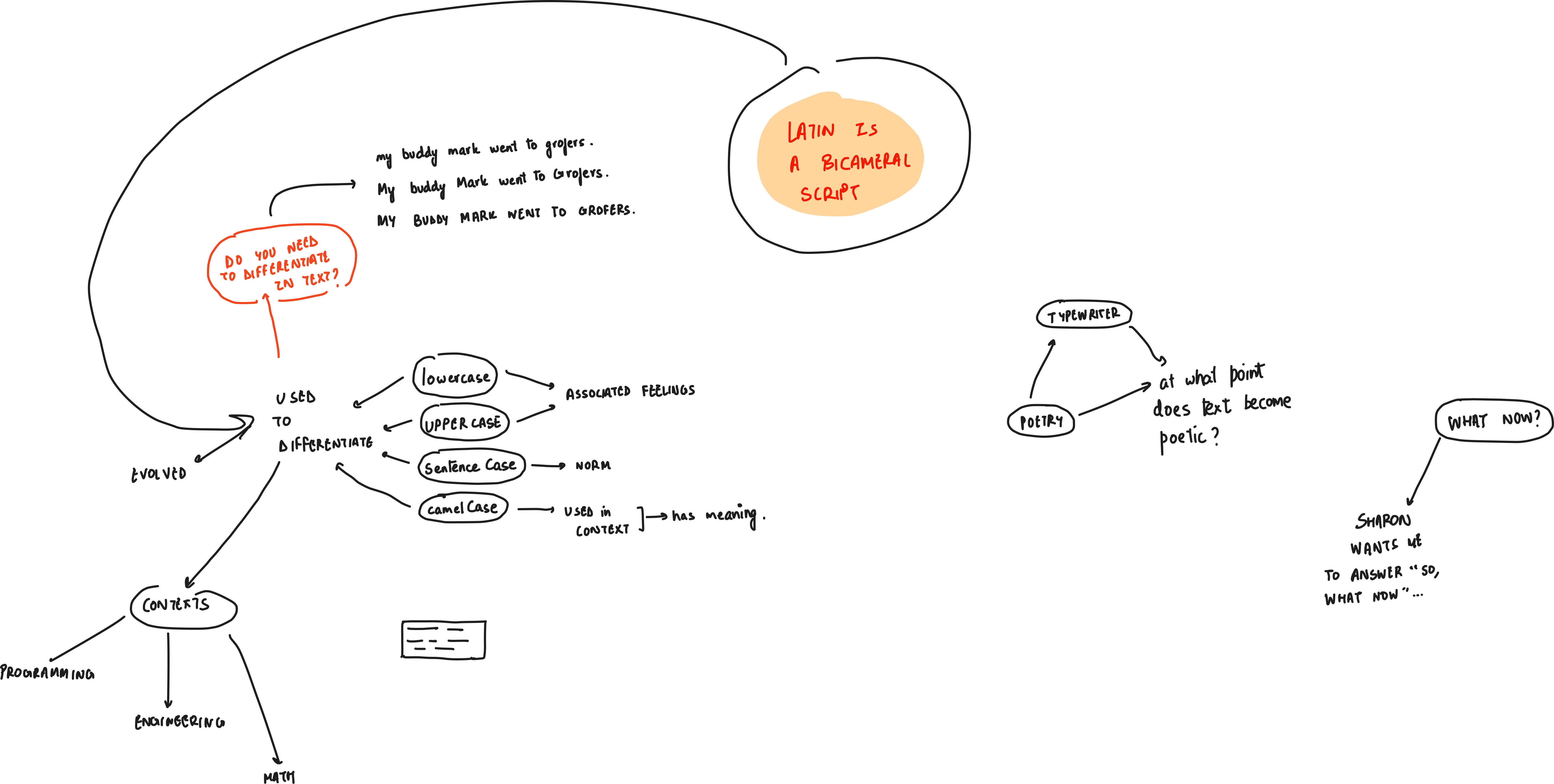
so, i first thought about it and then read a bunch of things.
i then got annoyed and wrote sharon this email:
dear sharon,
for the last couple of days, i’ve just been bouncing around in circles. i need clarity on the ask, so i’d like to ask a few questions:
your central-question-ask mentions the words: “measurable outcomes” and “what can you measure (in a week)”. our conversation went to qualitative-data collection last saturday. so, my question is: are we only looking at quantitative data for this assignment? (because qualitative data cannot be measured, and, therefore, will not meet the ask set in your brief). if not, then what is wrong with the varied outcomes that i might get in my experiement? i will, of course, analyse the data to uncover themes & patterns (which will group individual responses to more collective ones).
next, what are your factors for a ‘passable’ central question? because, when i read the brief, and think about your answer to my question in class, my initial central-question meets those requirements: specific interest, scratches curiosity, invites investigation, am conducting an experiment, is feasible, is related to the work i shall do (i will communicate with human-beings forever), gets me to reflect on making-methodology, practices communication (because i will focus on the writing), et-cetera. a list would help, so that i can align my curiosity with the ask of the class.
lastly, if i understand correctly, the objective of this assignment is not to produce new knowledge. why, then, must i uncover something that has not been documented before? when i conduct the same experiment, all the variables change — i am interacting with my friends, in another environment, et-cetera. so, the values will also change. the design of my experiment will also be different than others — because i am not looking for scientific validity. so, even though — say — brands have ‘understood’ that writing in lowercase feels more friendly (or whatever), the experiment was more around my communication with friends — how does the image of me change if i write with a different case? isn’t that a valid experiment? because we weren’t going for scientific accuracy anyway.
i am very confused and the 20-minute session last time did not help. the answer to (2) would help greatly. thank you!
and, you asked me “so what” — as in how will understanding this help me? but it will — people in the world still write in sentence-cases (the reasons for which i will uncover in the essay (letterpress-remnant, need to distinguish, english being a bicameral language (or so it is thought), et-cetera.)). gah, i’m confused!
best,
arjun.
and then we hopped on a zoom-call to resolve this.
i understood that her concern was about application (makes sense since the class is about ‘application’).
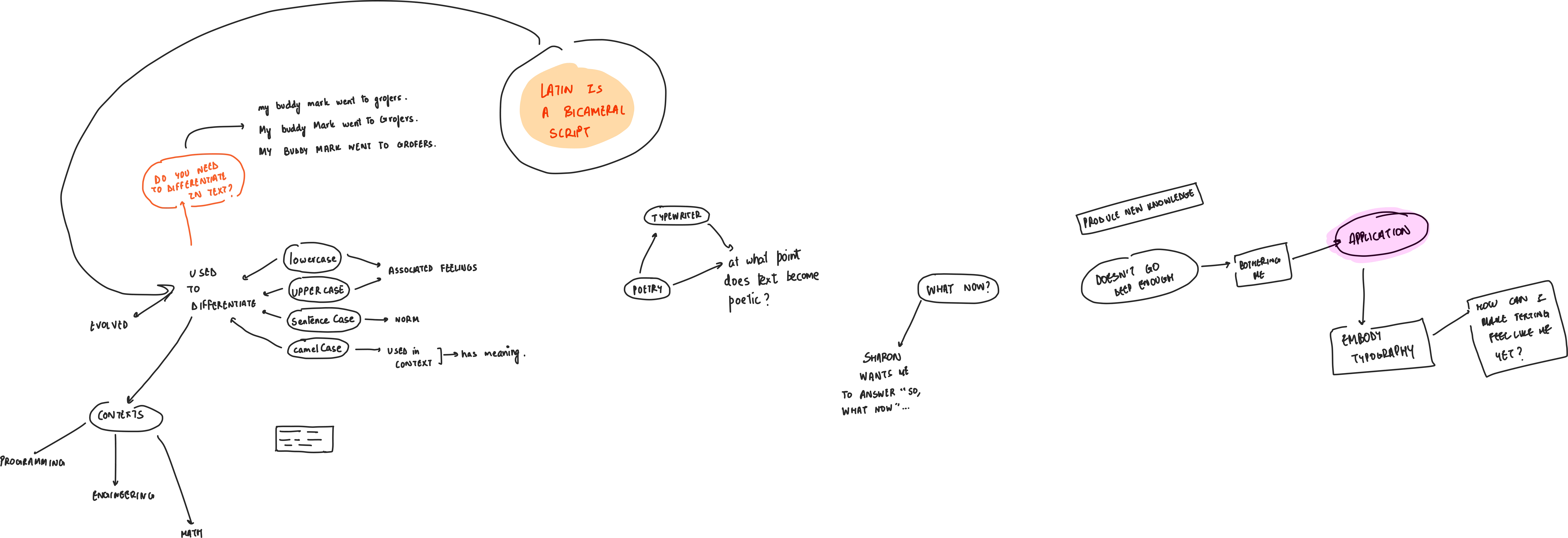
my question changed many times.
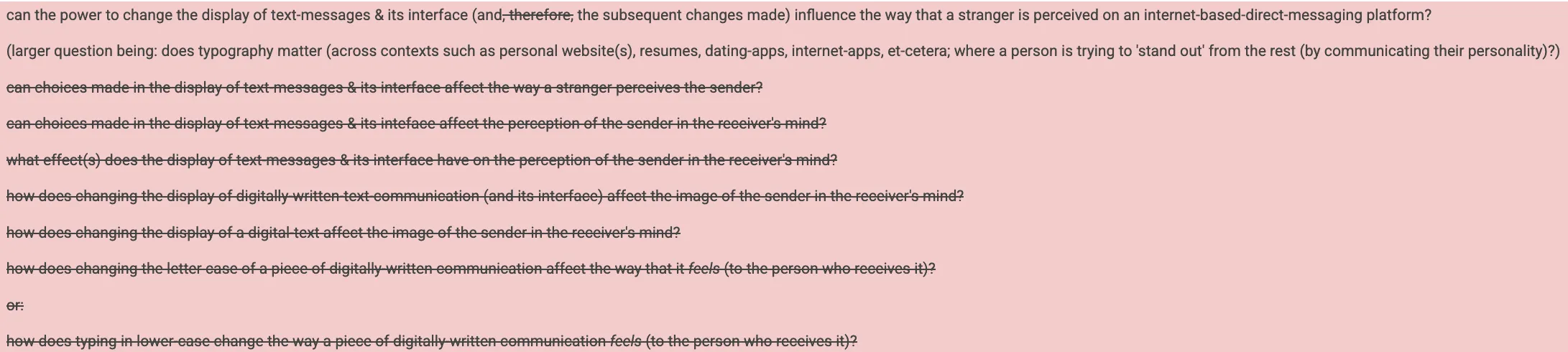
the final question then arose from the following lines of thought:
- we communicate frequently with strangers on the internet; meaning that we form a sense of their personality based on their messages.
- johanna drucker, in graphic devices: narration and navigation argues that “graphic elements do more than structure the conditions in which narration is produced … they contribute to the production of the narrative in substantive ways.”
- david (jhave) johnston, in the assimilation of text by image, presents the case of embodied typography; more particularly: “What these features share is that they are all primarily attributes of matter. They reference the world directly in ways that do not require literacy; they are read by experienced embodied subjectivity. As humans, we have tasted honey, known or heard of gold, walked a labyrinth (or studied a curl of smoke), and held things in our hands. So the typography is speaking to the body at a lived level. It is engaging with the energy of our hands, muscles, and tongue.”
- the above two points clearly indicate that the display of words has immense power over the narrative.
- however, if you look at most interfaces today, especially ones where we share our narrative especially via written word (and not images) (such as dating apps, blogging platforms, social-media, et-cetera), the ability to customise the display of letterforms (and its interface) is not provided to a person. essentially, we are robbing people of powerful ways to express them.
- but, this argument is moot if i cannot prove that intentional changes in typography can make a message feel more like a person.
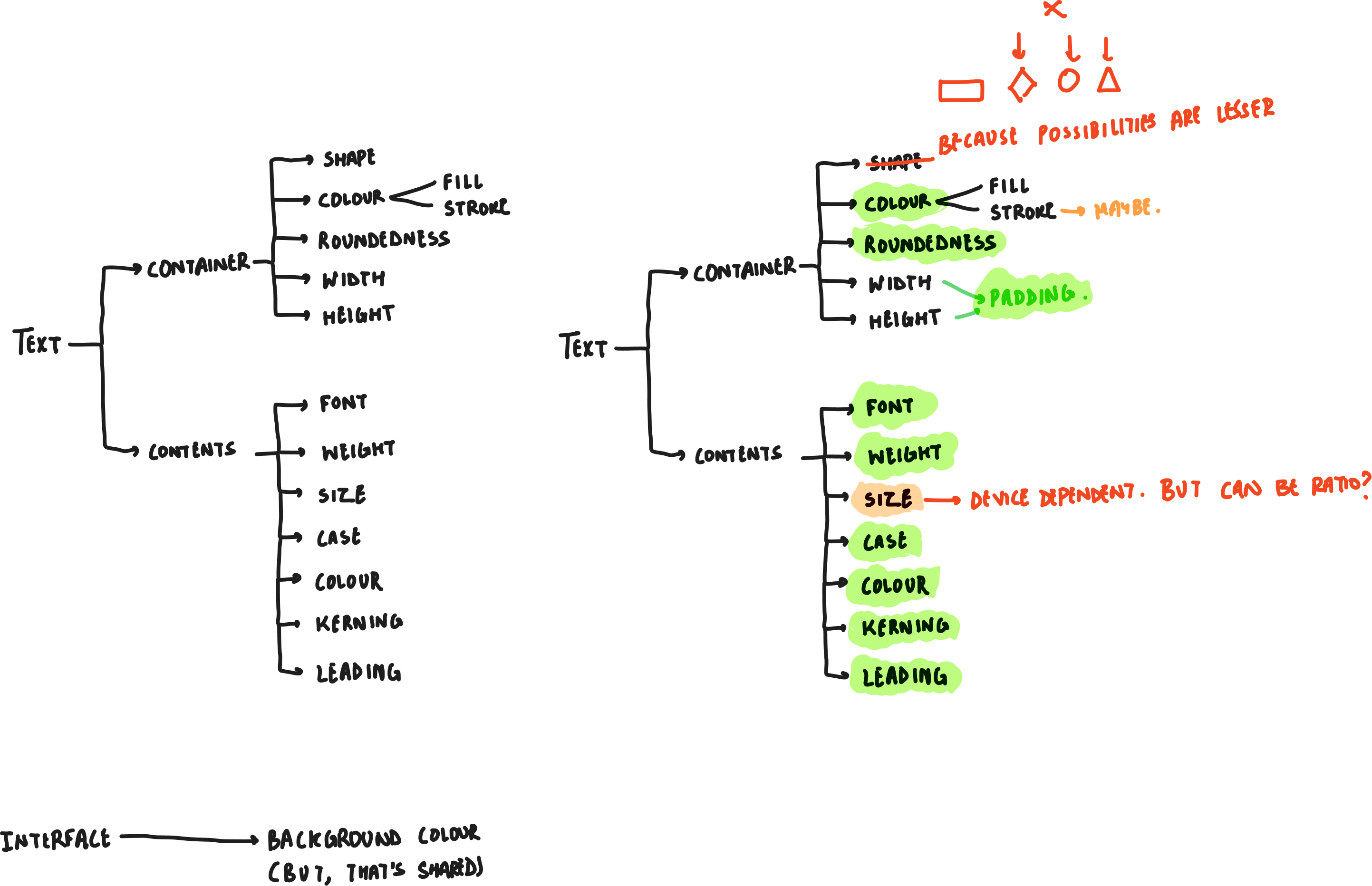
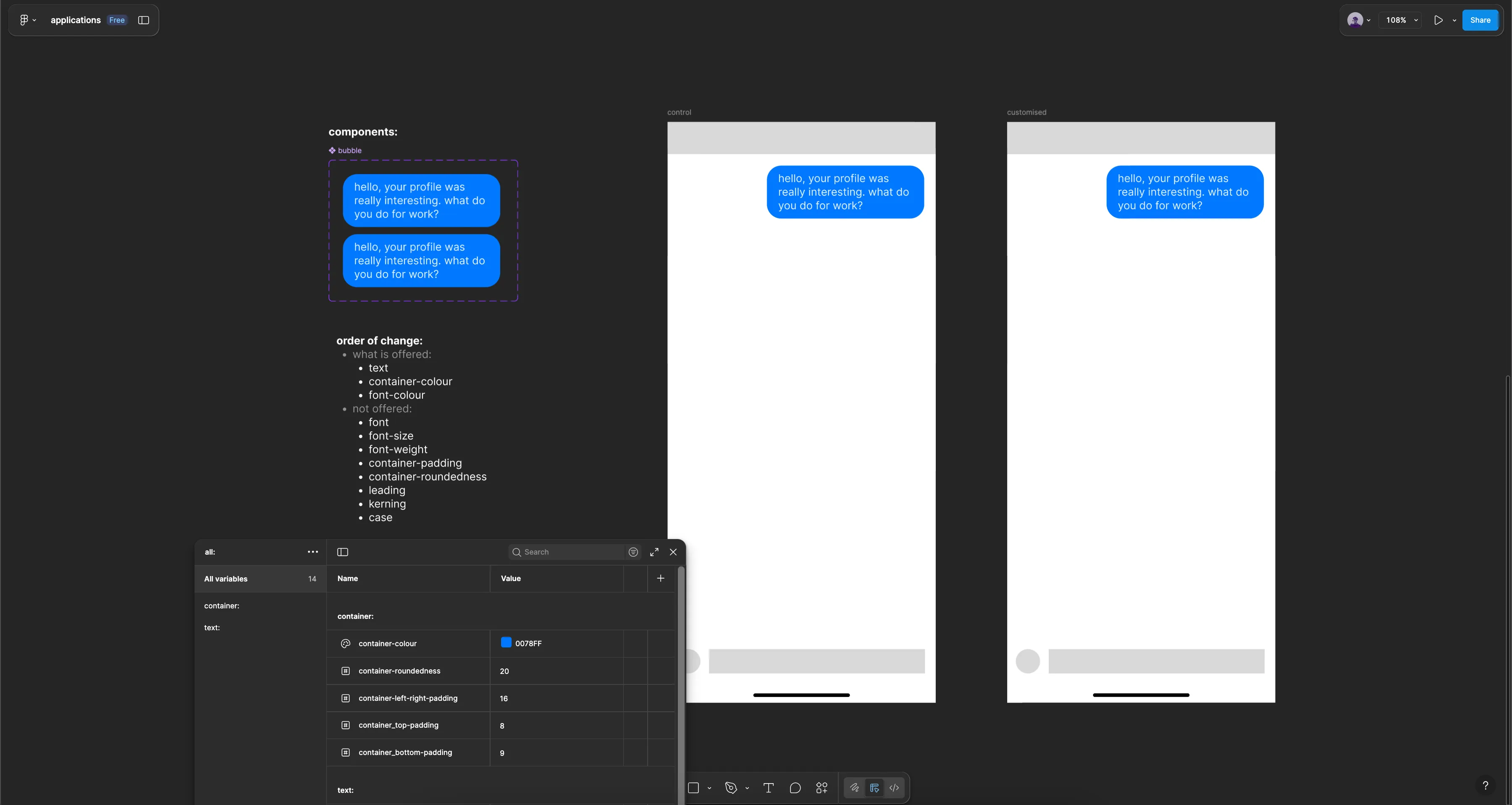
i then narrowed down the parameters of text:
then, thought of the experiment:
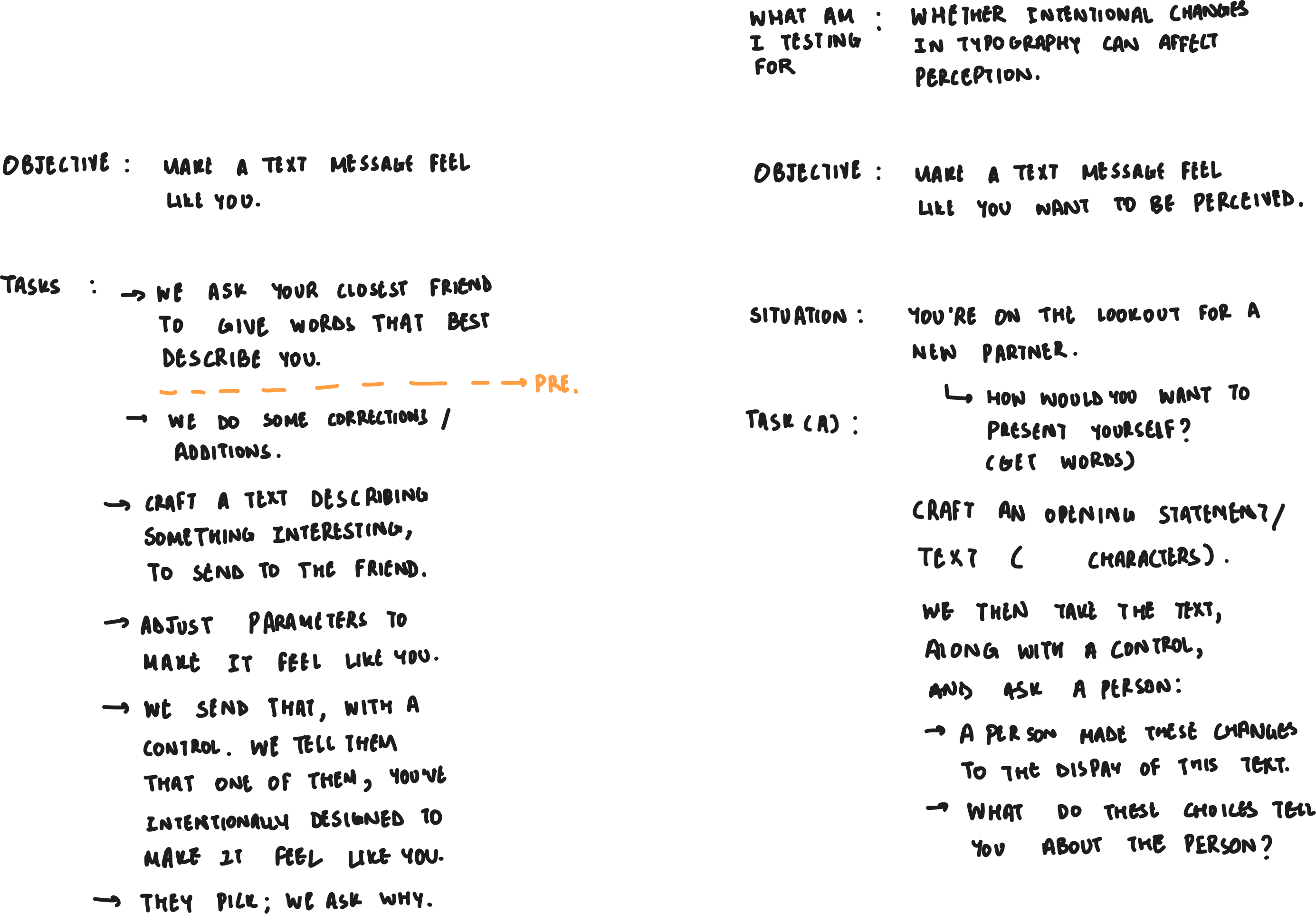
i had two lines of thought. one was motivated by the idea of getting more people to try it (by asking people if they wanted to know whether their best friend knows them well, to be able to get more people for my experiment), and the other one was truer to my question.
so, i chose & developed the second one.
i then set up an interface where people could change different typographic settings.
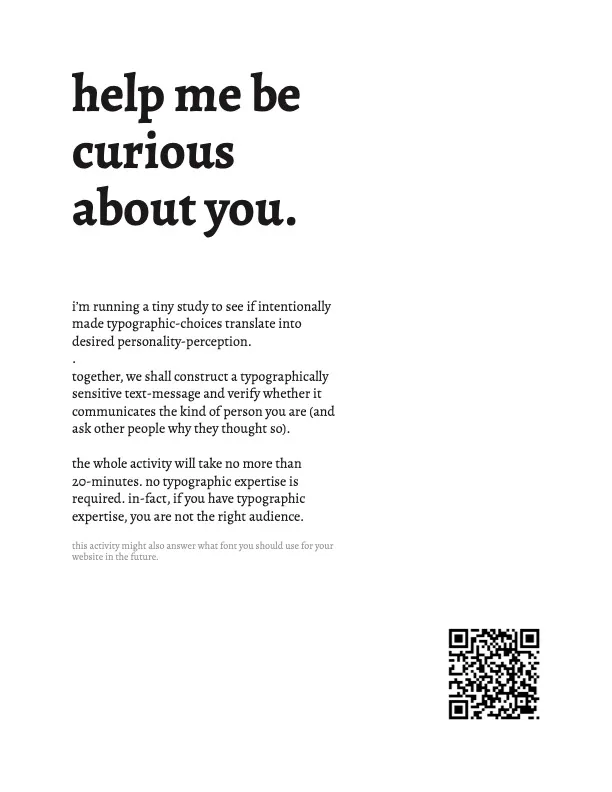
and made an advert to stick on the walls of the floor:
wrote drafts here: essay writing.
submitted this: